The best finish is not the one with the most impressive name. It is the one that suits how you use the table and how you are prepared to care for it. With timber and resin, that means considering the complete surface, rather than the coating on the wooden section alone.
The short version
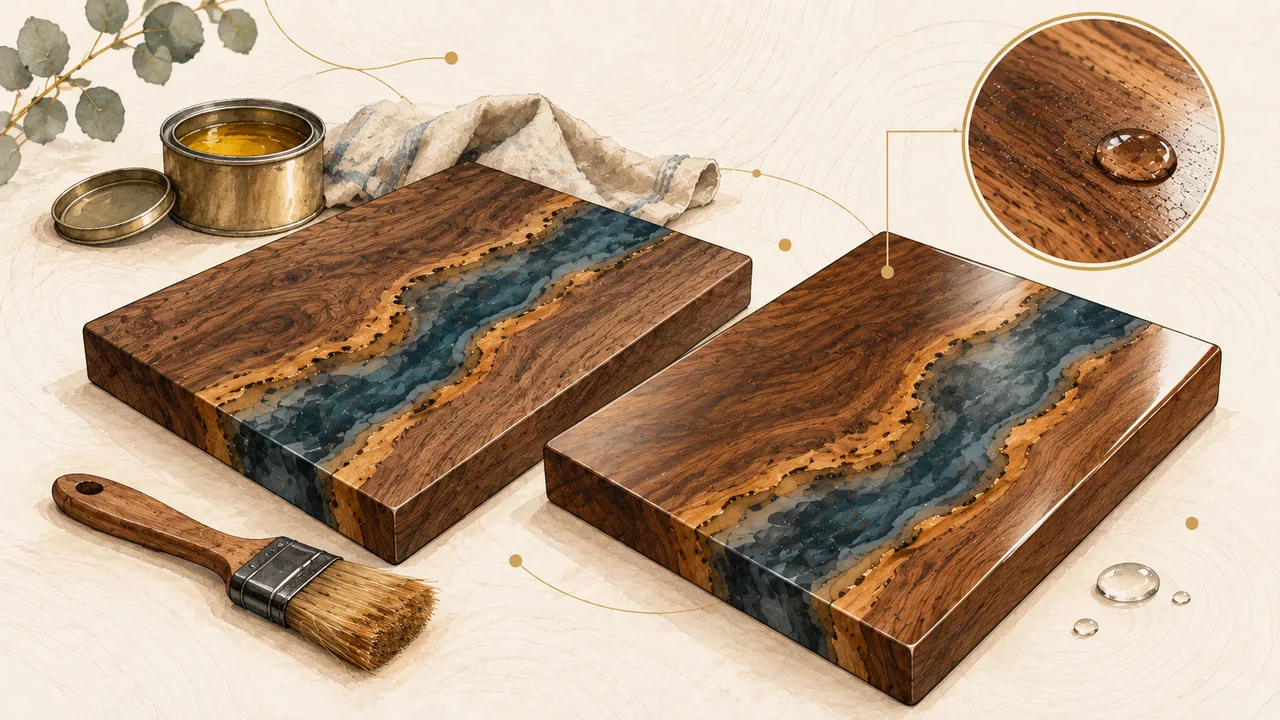
An oiled or hardwax-oiled finish often appeals if you enjoy a more natural feel and accept some ongoing care. Lacquer creates a continuous film and may suit a particular cleaning regime. Neither category has just one level of performance.
The precise product, preparation, application and cure all matter. Two tables described as “oiled” may behave differently. There is no honest all-purpose winner without considering the proposed finish and, where necessary, a sample.
What the differences mean in practice
On a smaller screen, swipe sideways to see the full table →
| Consideration | Oil / hardwax oil | Lacquer |
|---|---|---|
| Feel and appearance | Often closer to the timber’s natural texture; system-dependent | A continuous coating, available in matt as well as gloss |
| Routine care | Cleaning and compatible renewal as the surface needs it | Gentle cleaning and protection of the coating |
| Local repair | Possible with some systems; colour transitions need checking | May require a wider area to be refinished consistently |
| Resistance | The word “oil” is not a performance specification | The word “lacquer” is not a performance specification |
| Choosing from a photograph | It cannot show feel or stain response | It cannot show coating build or repairability |
Water, wine and coffee: ask the useful questions
Resistance to a liquid also depends on how long it is left there. A splash wiped away immediately is not the same test as a wet glass left overnight. Ask what the recommendation is based on and how to deal with a spill without making matters worse.
Be cautious of promises that a surface will “never mark”. It is more useful to know what to clean it with, what to avoid and when to contact the maker. Use protection beneath hot items and do not leave spilled liquid sitting on the table.
Repairability means more than being able to sand it
A scratch needs assessing by depth, direction, pigment and position. A local repair may be technically possible yet still visible in raking light. With coloured timber or a resin interface, matching both tone and sheen matters.
Do not start refreshing an oiled top with whatever oil happens to be in the cupboard. Osmo, for example, gives care instructions for its TopOil system; these cannot simply be applied to another finish. At handover, keep the name of your actual coating and the recommended care method. That makes future advice much more useful.
What changes when the table includes a resin river?
The same operation can produce a different appearance on timber and resin. A treatment that brings out the grain may not achieve the intended effect on a clear river. We therefore consider the completed surface: colour, sheen and its appearance under light from the side.
Avoid sanding a small patch beside the river without knowing the finishing system. You could change the sheen, soften an interface or create an obvious patch. Photographs of the mark in daylight and raking light are a better first step than reaching for abrasive paper.
A family kitchen and a business interior have different briefs
At home, feel and the ability to refresh the surface may come first. In a workplace, regular cleaning and clear instructions for the cleaning team can be just as important. If disinfectants are used, compatibility needs checking against the actual product. “Wipe-clean” does not mean resistant to every chemical.
Tell us who will clean the table and what they use. If your organisation has a fixed cleaning procedure, send the product names. The specification should follow real use, not just the way a showroom sample looks.
What to confirm before the table is made
- The exact finish, tone and sheen on an approved sample.
- When normal use can begin after the final application.
- The recommended cleaner and products to avoid.
- Options for local repairs or a complete refresh.
- Care of both the timber and resin sections.
At Ahoj Epoxy we discuss these points during design. The aim is not to sell a more complicated coating, but to hand over a table you know how to look after. Our resin table care guide covers further everyday advice.
Your questions answered
Is a matt table always oiled?
No. Lacquer can also be matt. Appearance and finishing technology are separate things.
Should I re-oil it once a year?
There is no universal interval. Follow the particular system and assess the condition of the surface and the use it receives.
Does a food-contact finish make the whole top suitable for chopping?
No. The intended use of a coating does not automatically turn the complete piece into a chopping board. Suitability must be established for the whole construction.
Technical references and practical guidance
We checked the technical background against the primary references below. Materials and methods are specified for each commission; a reference does not imply that its manufacturer supplied the documented project.
Bespoke tables from the Ahoj Epoxy workshop
Choose a finish that fits your routine
Tell us how the table will be used and cleaned. We can suggest a surface and explain the care it will actually need.